


Thrutopian Writing – a new genre for a new world
by Manda Scott

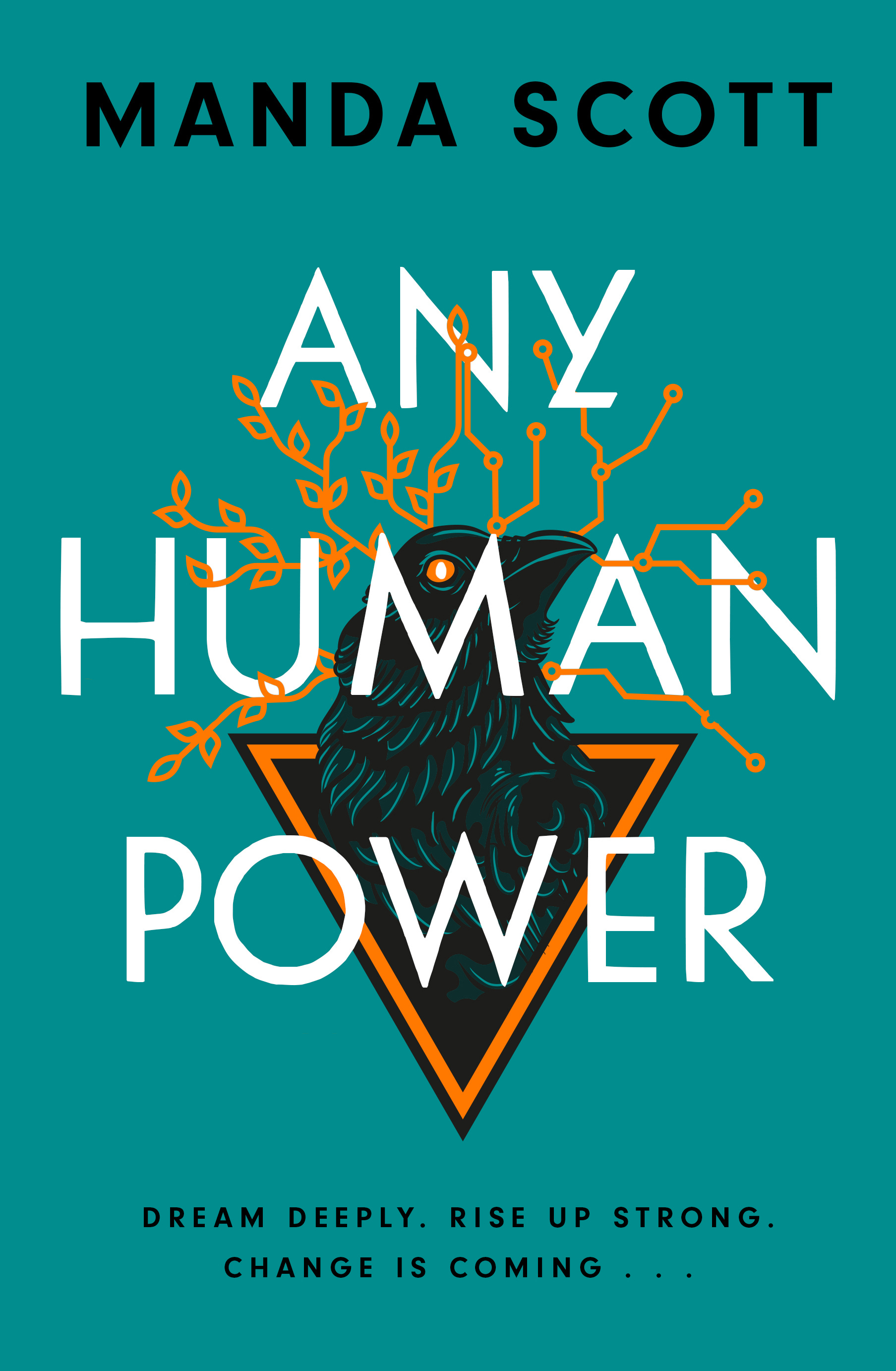
Manda Scott is the author of a new cli-fi thriller Any Human Power. A family of young truth seekers find themselves at the heart of a global uprising, battling the all-powerful wrath of the old establishment who deeply fear an empowered youth. The story combines a gorgeously-crafted mystical storyline with the heart-pounding, modern-day narrative set in a grim reality of corruption and internet scandal.
We live in capitalism. Its power seems inescapable – but then so did the divine right of kings. Any human power can be resisted and changed by human beings. Resistance and change often begin in art. Very often in our art, the art of words.
– Ursula K le Guin, Speech to the National Book Awards, 2014
Our art is the art of words. Our culture is a culture of words.
Ursula le Guin spun us a challenge, and we’re doing all we can to foment resistance and change: ‘we’ who are writers, podcasters, poets, scriptwriters, bloggers of regenerative farming; those who are engaged in alternative politics, community food projects or land banks; co-housing groups experimenting with sociocracy, co-operative architecture practices, zero-carbon cities, or bio-regional banks experimenting with ideas that could yield a whole new global reserve currency…
There are a lot of us. And yet the narratives of Business As Usual and ‘There is No Alternative’ still steer the ships of our societies and our states. In the wild lands of Britain where I live, the Death Cult of predatory capitalism has had at least two thousand years to establish the concept that who dies with the most toys wins. These days the big toys are lunar rockets, and winning is the capacity to shape the emerging silicon-based intelligence in your own ideological image, to state that the web of life is an ‘aesthetic option’ which can be discarded with no impact on things that matter (to you).
And yet…le Guin offers a shining star when the going seems dark, not just because she had visions of a different world and wasn’t afraid to express them, but because she modelled on the page what change and resistance might look like.
Indeed, the whole notion of Thrutopian writing arose from a 2017 article in Huffington Post by Prof Rupert Read, climate philosopher and co-founder of the Climate Majority Project in which he cited le Guin’s ‘The Dispossessed’ as the original Thrutopian novel.
“That sci-fi work brilliantly juxtaposes a superficially-attractive but dystopian world of extreme inequality and only marginal democracy (a world disturbingly like our own) with what appears at first to be an anarchist utopia. But the true genius of the novel is one's gradual realisation that utopia could never be static. Any true utopia demands being continually remade. In this way, we come to understand that any utopia has to be what I call a thrutopia, on a long-term basis. On, to be precise, a pretty much permanent basis. Thrutopia isn't second best, it's the genuine article.”
Thus, Read defines Thrutopia as a long-term Utopia. I’ve expanded on this to suggest that a Thrutopia crucially needs to offer at least one plausible, inspiring, grounded route map through from exactly where we are to a future we would be proud to leave to the generations that come after us.
In this genre, we’re explicitly aiming for a point where seven generations down the line, those who are alive look back at us and say, ‘Yes, they left it way, way too late; but when it really mattered, they got together and turned the whole amazing power of human creativity onto the problems of the moment. They found common values, and ways of expressing them, that would let them dismantle the old ways of being, to enable the flourishing of connection, sufficiency and agency. And here we are. And here is good enough to build on.’
To an extent I’m borrowing from Ronan Krznaric, whose book The Good Ancestor is essential reading for anyone ready to break out of the constraints of mainstream thinking. But I’m going beyond this, to the nature of communication. If we’re going to inspire people to real change (what else are we here for?), we need to expand their thinking. And this means expanding our own.
A basic axiom of writing is that we can do the research and then write about all kinds of practical, logistical events, structures and ideas, but we can never write beyond the limits of our own emotional intelligence. So if we’re going to write new ways of being, we have at least to touch the edges of them ourselves. Which means we need to have a clue about where we might start.
In this regard, I’d like to commit a minor heresy and suggest that le Guin notwithstanding, revolution is not, after all, what we need. As Reiki Cordon of the Seeds network says, ‘Revolution only gets you round in a circle to where you started.’ He would prefer us to aim for Renaissance/Renewal. I’d go further, to say we need to retrieve the best of who we have been and weave it through the best of who we are now, to produce a way of being human that has never been seen before.
I’m building here on Frances Weller’s concepts of Initiation Culture vs Trauma Culture, the idea that throughout human history – and in some few places, even in the present – there exist(ed) cultures where each individual was held through a contained encounter with death and emerged from it stronger, more self-aware, more humble, more able to connect with the wider web of life - and divested of the belief that it might be possible for any human mind, however brilliant, to work out the answers to all the possible questions life might throw at us.
In our current Trauma Culture, by contrast, we are not held. Our encounters with death are not contained by our elders, communities, ancestors, or the land itself. We have no rituals by which we might come to know the best of ourselves, to experience the celebration of our strengths by our peers whose strengths we likewise celebrate. Absent all this, our traumas become foci of pain and wounding. We fall back into our old stories of separation, scarcity and powerlessness which drive all our actions.
How do we in the twenty-first century build our rituals? How do we find our elders, and the communities that might hold us? How do we find the best of ourselves, so that we can trust that our web of connections is there to hold us in our moments of pain and uncertainty?
Here, I want to bring in the words of Oscar Miro-Quesada, quoted by Nina Simons, co-founder of Bioneers, in her book Nature, Culture and the Sacred.
"Consciousness creates matter,
Language Creates Reality,
Ritual creates relationship”
Language creates reality. We know this. We are a League of climate fiction writers. We create our own realities. We can also, if we choose, start shaping rituals that would re-create relationship. We can write elders with profound wisdom, and communities where the serotonin mesh of holding is strong enough to withstand profound disruption. We can write our books as route maps through to ways of being that transcend the hero-zero sum games of the present.
In doing so, we can make change. Human beings are complex organisms, and part of the wonder of our being is that if we can imagine something in ways that feel real to us, we will store this thing as memory, and we will access it as if it had been real when we need help.
This is the basis of so many false witness statements from people who believe they are speaking the absolute truth to the jury in front of them. But it is also the miracle of human connection, of communication. It is the reason our route maps are worth crafting.
I’m not suggesting it’s easy. I thought writing historical novels was hard, that moving from the Boudican era (replete with rituals of connection) through to fourteenth century France, through to the twentieth century in all its ideological chaos, was mind-bendingly difficult. Then I started to write a Thrutopia, for which I had to find plausible, grounded, inspiring routes from where we are to where we need to be to leave a flourishing web to those who come after us. Then I found what hard really is. But writing the past wasn’t working any more. The whole narrative that said, ‘if we knew who we were, we’d know who we could be’…this wasn’t a thing.
If we knew what we could be, though, if we could feel it and taste it, weep for it and shout for joy over it in the ways that the best fiction can bring us to…this could be a thing, I think. And well worth aiming for. All we have to do is immerse ourselves in the possible. And then the improbable will be ours for the making.
Find out more about Any Human Power.
Novelist, columnist, blogger, podcaster, broadcaster and red-green activist, Manda Scott’s novels have been shortlisted for an Orange Prize, nominated for an Edgar and dived into the endless iterations of TV adaptations. She’s currently host of the THRUTOPIA MASTERCLASS which is helping a whole generation of writers to craft plausible, generative, thriving, near-term futures we’d be proud to leave to our children – and map the routes to get there.
Her latest novel, A Treachery of Spies weaves a contemporary crime thriller with the courage and heroism of the Special Operations Executive in WW2.
She’s written a Thrutopian TV series and is working on a Thrutopian novel. Because we have the answers to a flourishing future, we just haven’t created the visions that will draw people towards them.
When not writing, she is host of the Accidental Gods podcast, and runs a horticultural smallholding, which one day will feed the local community.
Solutions Spotlight
In this issue’s extract from a book featuring a climate solution, Aaron Arsenault shares an extract from his MG novel The Climate Diaries, where characters use red seaweed to curb bovine methane emissions for a group science project to curb bovine emissions. The kids meet at the stables to discuss their project and brainiac Jax wants to concoct his own red seaweed.
“It smells like poo!” Grace said, disgusted as she examined the bottom of her boot. “Gross.”
“I take it you’ve never been to a farm, mate,” Kylie asked.
“Umm, no,” she gagged.
“Alright, let’s do this thing. Throw some ideas at me . . . We gotta win.”
August spoke up, “What if we build a computer model that will tell us . . .”
“Boring!” Grace said, cutting him off . “What about you, oh nerdy one?” Grace sneered at Jax. “You must have some big ideas cooking in that big noggin of yours.”
Jax thought for a minute and stated confidently, “The key to a desirable output lies in the quality of input.”
“What the heck are you talking about, bro? I don’t even know what that means.”
“I think we should change what the cows eat so they produce less methane,” Jax answered. “Simple.”
“Great idea, mate.” Kylie said. “What should we feed them?”
“Well, there’s this very specific type of algae,” Jax began.
“Algae?” Grace exclaimed.
“Yeah, you know, seaweed? It’s called Asparagopsis taxiformis.”
“I know what algae is, Wilkinson,” Grace replied.
“Yeah, but it’s not just any seaweed,” Jax answered, tearing out a page from his notebook. “Here – I wrote some notes.”
Asparagopsis Taxiformis.
“Aspara-what?” Grace said, trying to pronounce it. “What the heck are these doodles supposed to be?” she said, looking at the page, bewildered.
“It’s a diagram of structural formula depicting the chemical compounds that inhibit the cow’s methane production. Duh . . .”
Grace shrugged. “No more nerd talk! Please! I can’t take it anymore!”
“It’s simple. The compounds act as an antibacterial agent to stop the cow’s microbiome from producing so much methane . . .”
Grace shrugged again. “You keep saying that. It’s not simple to me, okay!”
“Alright, fine. Just call it red seaweed! I’m not making this stuff up, Grace. Go ahead and Google it.” Jax answered. “Trust me, it’s awesome. I’ve bioengineered my own.”
Grist Climate competition open for entries
Grist is excited to open submissions for the fourth year of our Imagine 2200: Climate Fiction for Future Ancestors short story contest.
Imagine 2200 is an invitation to writers from all over the globe to imagine a future in which solutions to the climate crisis flourish and help bring about radical improvements to our world. We dare you to dream anew.
In 2,500 to 5,000 words, show us the world you dream of building.
Your story should be set sometime between the near future and roughly the year 2200.
There is no cost to enter. Submissions close June 24, 2024, 11:59 p.m. U.S. Pacific Time.
The winning writer will be awarded $3,000. The second- and third-place winners receive $2,000 and $1,000, respectively. An additional nine finalists will each receive $300. All winners and finalists will have their story published in an immersive collection on Grist’s website.
New UK Climate Fiction Prize
A new, major literary award, The Climate Fiction Prize, has launched in the UK, supported by climate storytelling organisation Climate Spring. The Prize’s aim will be to showcase novels of powerful literary merit and to solidify, grow and expand fiction that engages with the climate crisis. The prize’s inaugural year will bring together a stellar panel of judges from the literary and climate worlds.
Submissions will open on Monday, 3rd June 2024. The longlist and shortlist will be announced across autumn/winter and the winner will be announced in spring 2025 and receive an award of £10,000.
Climate Spring works with creatives, producers and commissioners around the world to support the development of new narratives for the climate crisis. Climate Spring is a company that provides funding, editorial consulting, advice and support to the screen industry to tell stories through film and TV, and are supporting the Prize to grow the profile and reach of climate fiction.
Well said! "Perfect" won't be accessible, but representing environments working through what's challenging and demonstrating fundamental improvements for our ecosystem's conditions - that can help spur motivation productively.
Delighted to read this article, and to see that you are (As Suzanne Taylor did this Spring) offering cash prizes for such a worthy cause. Your ideals, Suzanne's and my own are pretty much aligned. I would like to promo you in the same way I promoted her Essay, and trust that you have no objections. You can read what she says about me in the post on my Stack tomorrow. I have already restacked yours of today. Best Wishes, Maurice